
This video examines the statutory requirements for record keeping and reporting by sub-contractors under qualifying sub-contracts. Chapter 6 of the SSRO’s guidance on qualifying sub-contracts includes guidance on record keeping and reporting.
TRANSCRIPT AND SLIDES AS USED IN THE VIDEO:
SLIDE 1
This video examines the statutory requirements for record keeping and reporting by sub-contractors under qualifying sub-contracts.
SLIDE 2
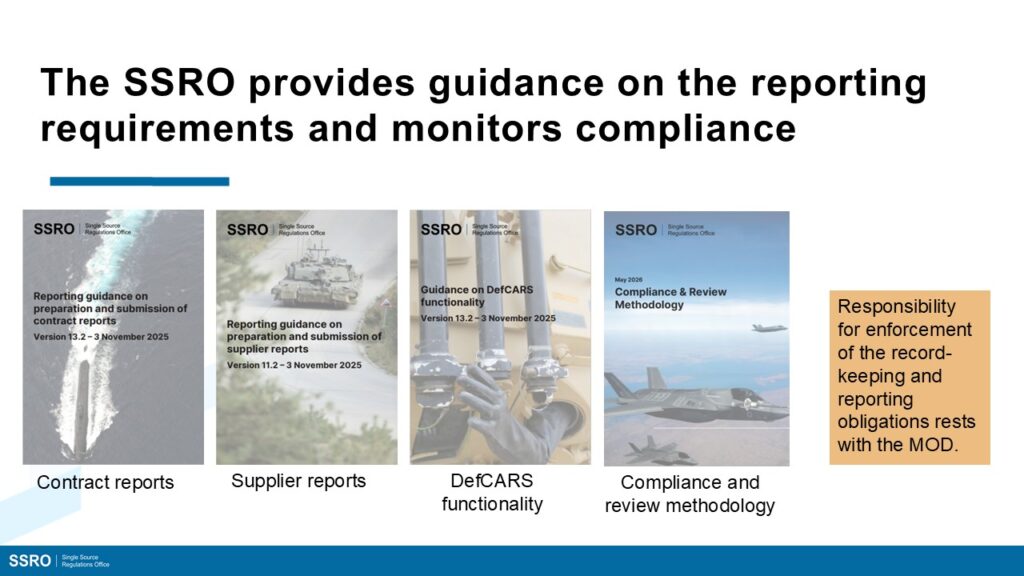
The Defence Reform Act 2015 and the Single Source Contract Regulations 2014 require contractors with qualifying contracts to keep written records pertaining to those contracts and to provide information about those contracts and, in some cases, their operations to the Ministry of Defence and the SSRO via statutory reports. These transparency requirements apply to QSCs (and to sub-contractors) as they apply to qualifying defence contracts (QDCs) (and to primary contractors), subject to certain modifications.
The SSRO provides a range of guidance on the completion of statutory reports to which contractors and sub-contractors must have regard. The guidance applies both to QDCs and to QSCs. Any differences between the reporting requirements for QDCs and QSCs are relatively minor and are identified by the SSRO where appropriate in its reporting guidance.
The SSRO also provides an online, web-enabled system called DefCARS (the Defence Contract Analysis and Reporting System) to facilitate the submission of statutory reports to the SSRO and MOD.
All the reporting guidance is available on the SSRO’s website.
The guidance covers:
- The completion of contract reports
- The completion of supplier reports AND
- The use of DefCARS
The SSRO’s reporting guidance is updated periodically in response to issues raised by stakeholders or where improvements are identified by SSRO staff.
The SSRO has also published its compliance methodology setting out how we keep under review the extent of contractors’ compliance with reporting requirements.
Responsibility for enforcement of the record-keeping and reporting obligations rests with the Ministry of Defence, which may take enforcement action in cases of non-compliance.
Section 6 of the SSRO’s QSC guidance summarises the regulatory reporting requirements and highlights the main ways in which these requirements are modified for application to QSCs and to sub-contractors under those contracts. The next few slides will cover the main points from the QSC guidance.
SLIDE 3
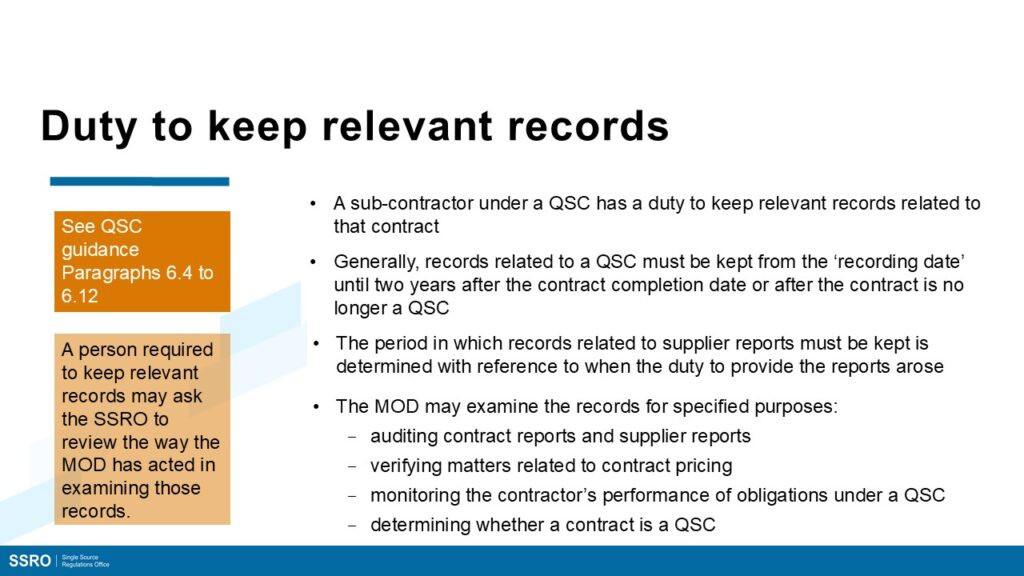
A sub-contractor under a QSC is required to keep relevant records (which may be accounting and other records) pertaining to that contract, in either hard or electronic form over a specified period of time. The records should be sufficiently up-to-date and accurate.
Generally, a sub-contractor under a QSC has a duty to keep relevant records related to that contract and any contract reports required under Part 5 of the Regulations from the ‘recording date’ (which is determined with reference to the process which led to the award of the QSC) until two years after the contract completion date or, where the contract is determined no longer to be a QSC, the date of that determination.
The period during which a person who must provide supplier reports under Part 6 of the Regulations is required to keep relevant records is determined differently, with reference to when the duty to provide those reports first arose (which is the first day of the designated person’s accounting period relating to the relevant financial year for which that report is provided.).
The SSRO’s QSC guidance provides more detailed information on when the duty to keep relevant records commences and ends.
The MOD has the right to examine the sub-contractor’s records for specified purposes which are:
- auditing contract reports and supplier reports
- verifying matters related to contract pricing
- monitoring the contractor’s performance of obligations under a QSC
- determining whether a contract is a QSC.
A person required to keep relevant records may request that the SSRO reviews the way that the MOD has acted in exercising its rights to examine those records. If the SSRO conducts a review and considers that the MOD has acted unreasonably in the exercise of its powers, the SSRO may make a declaration to that effect.
SLIDE 4
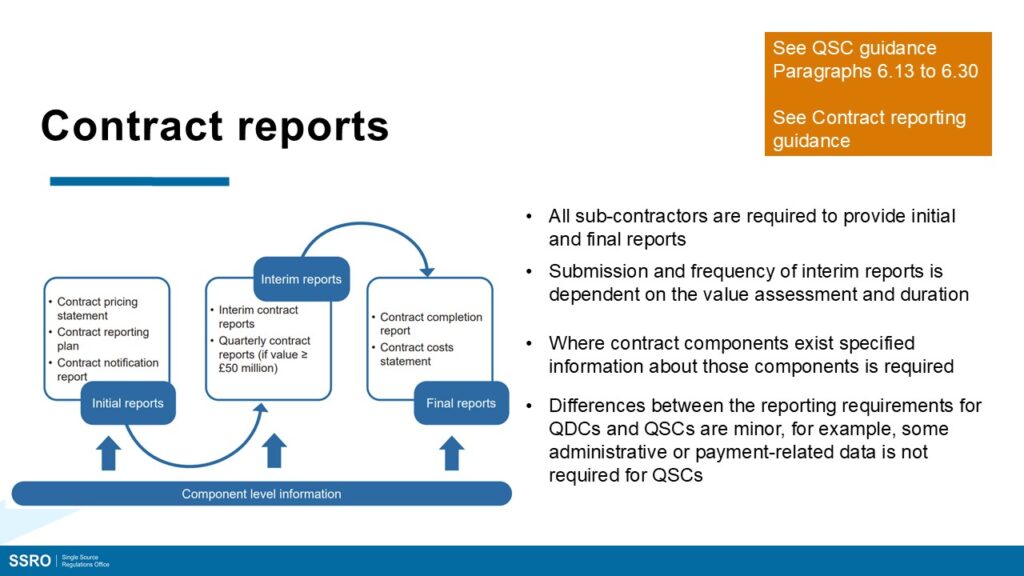
There are different types of statutory contract reports which sub-contractors may need to submit to the SSRO and MOD about their QSCs in order to comply with their reporting obligations.
The Initial reports comprise:
- the Contract pricing statement.
- the Contract reporting plan.
- and the Contract notification report.
The Interim reports comprise:
- Interim contract reports.
- and Quarterly contract reports (if the value of the contract is greater than £50 million).
The Final reports comprise:
- the Contract completion report
- and the Contract costs statement.
All sub-contractors under QSCs are required to provide initial and final reports. The initial reports are due within one month of entering into the contract. The final reports are due, respectively, within 6 months and within 12 months after the contract completion date.
The submission and frequency of interim reports is dependent on the value assessment of the QSC and its duration.
Where components are created in contracts, as well as providing information about the contract as a whole the sub-contractor must provide specified information about those components.
The QSC guidance highlights where the reporting requirements for QSCs differ from the requirements for QDCs. These are generally minor, for example, not requiring certain administrative or payment-related data that is required for QDCs.
SLIDE 5
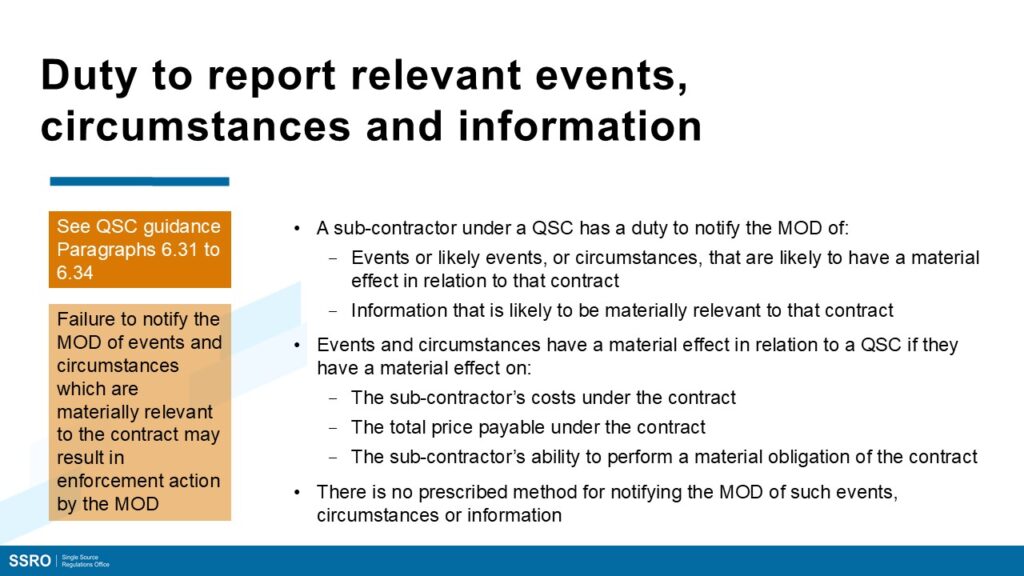
A sub-contractor under a QSC has a duty to notify the MOD of events or likely events, or circumstances, that are likely to have a material effect in relation to that contract, or information that is likely to be materially relevant to that contract.
The duty to notify arises at the point the sub-contractor becomes aware of the event or likely event, circumstance or information.
Events and circumstances have a material effect in relation to a QSC if they have a material effect on:
a. the costs of the sub-contractor under the contract;
b. the total price payable to the sub-contractor under the contract; or
c. the sub-contractor’s ability to perform a material obligation of the contract.
Information is materially relevant to a contract if it is materially relevant to any of those matters.
The legislation does not prescribe how the MOD is to be notified by the sub-contractor of an event or likely event, circumstance or information that is likely to have a material effect in relation to the contract.
One possibility is for the sub-contractor to notify the MOD via the Variance, Events & Circumstances page of a quarterly or interim contract report (if the submission of such a report coincides with the sub-contractor becoming aware of the event/likely event, circumstance or information) OR via an on-demand contract report (if no other contract report is due to be submitted by the sub-contractor when it becomes aware of the event/likely event, circumstance or information).
Another possibility is for the sub-contractor to notify the civil servant in the MOD responsible for managing the QDC which is ultimately enabled by the QSC in question, whose details should be sought via the contracting authority.
However the notification is provided, the subcontractor must notify the MOD on becoming aware of the event/likely event, circumstance or information.
Failure to notify the MOD of events and circumstances which are materially relevant to the costs, price or performance of the contract may result in enforcement action by the MOD.
SLIDE 6
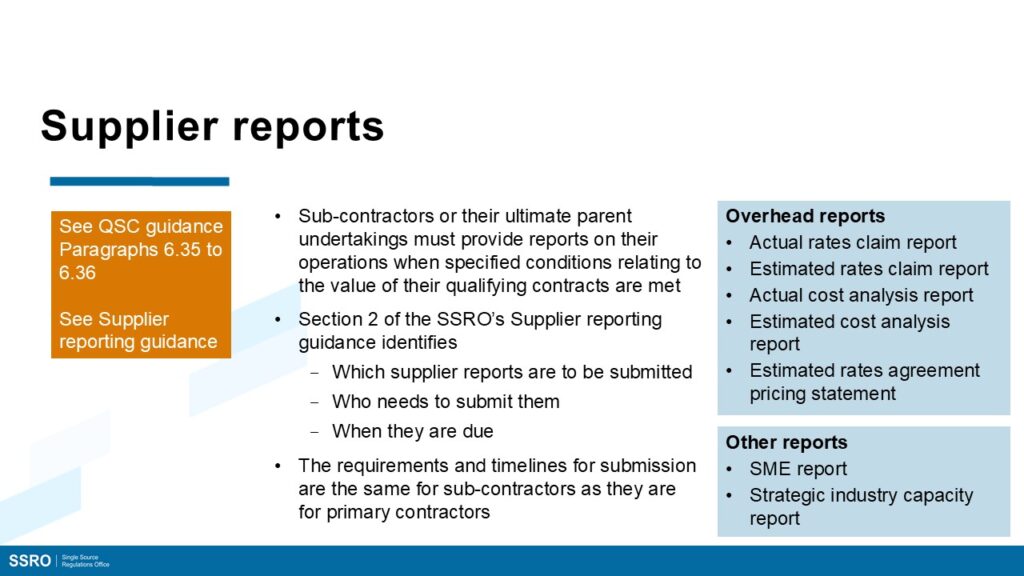
The Regulations require contractors or sub-contractors under qualifying contracts or their ultimate parent undertaking to provide a number of reports on their operations when specified conditions pertaining to the value of their qualifying contracts with outstanding obligations are met.
Section 2 of the SSRO’s supplier reporting guidanceprovides an overview of the reports which may be required to be submitted. These are:
Overhead reports, which consist of:
- the Actual rates claim report.
- the Estimated rates claim report.
- the Actual cost analysis report.
- the Estimated cost analysis report.
- and the Estimated rates agreement pricing statement
There are also ‘other reports’, which comprise:
- the SME report; and
- the Strategic industry capacity report
Section 2 of the SSRO’s supplier reporting guidanceidentifies matters that should be considered when determining:
- which supplier reports need to be submitted
- who needs to submit them and
- when they are due.
The requirements and timelines for submission are the same for sub-contractors under QSCs as they are for primary contractors under QDCs.
SLIDE 7

Thank you for your interest in this video. Should you have any queries regarding the content covered, or require further assistance on applying the regulatory framework for single source defence contracts, you can contact the SSRO’s Helpdesk at helpdesk@ssro.gov.uk