
This is a video on Assessing if a contract is a Qualifying sub-contract (QSC). Chapter 3 of the SSRO’s guidance on qualifying sub-contracts includes guidance on assessing if a contract is a QSC.
TRANSCRIPT AND SLIDES AS USED IN THE VIDEO:
SLIDE 1
This video is part of a series prepared by the SSRO, focusing on how the UK regulatory framework for uncompeted defence contracts applies to qualifying sub-contracts, or abbreviated to: QSCs.
The aim of the videos is to improve viewers’ understanding and subsequent application of the relevant regulatory provisions. Written guidance is also available on the SSRO’s website.
This video examines when and how to assess if a proposed contract is a qualifying sub-contract.
SLIDE 2
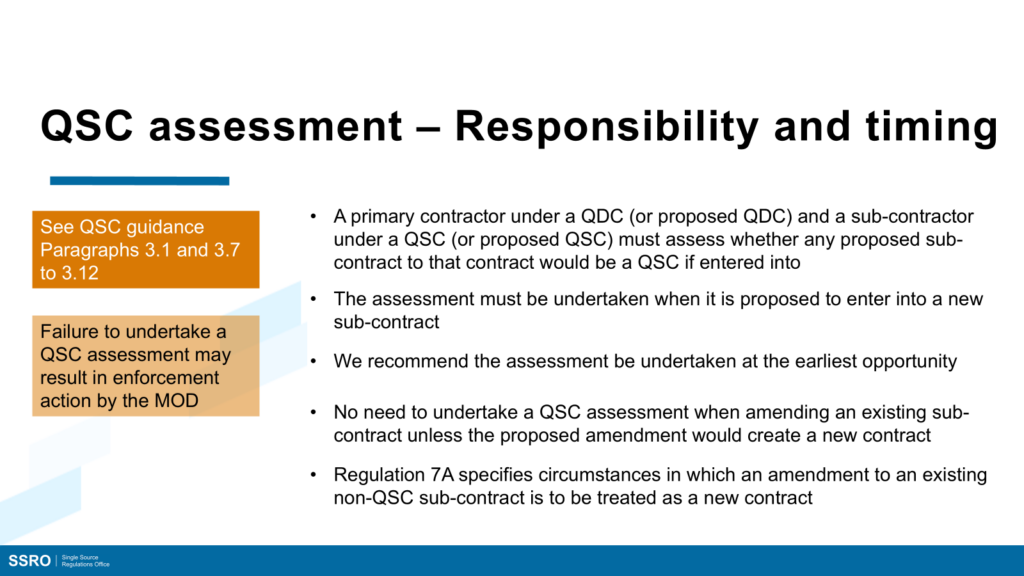
First, who must assess whether a contract is a QSC and when must they do that?
Primary contractors under qualifying defence contracts (abbreviated to QDCs) or proposed QDCs, as well as sub-contractors under QSCs or proposed QSCs, must assess whether any proposed sub-contracts to those contracts would be QSCs if entered into.
There is no need to undertake a QSC assessment for an existing contract which will enable delivery of a proposed qualifying contract.
Failing to undertake a QSC assessment may result in enforcement action by the Ministry of Defence against the contracting authority.
With regards to timing… the QSC assessment must be undertaken before the proposed contract is entered into.
The SSRO recommends that the QSC assessment be undertaken at the earliest opportunity. This will give the prospective sub-contractor under a contract which has been assessed as being a QSC if entered into the maximum time possible to understand the requirements of the regulatory framework. It also gives the prospective sub-contractor the opportunity, if it thinks it necessary, to lodge an appeal with the SSRO against the assessment before the proposed contract is entered into.
There’s no need to undertake a QSC assessment when proposing to amend an existing sub-contract which enables the performance of a QDC or QSC as it’s not possible for a non-QSC to become a QSC by amendment. Put another way, a contract which is correctly assessed before being entered into as not being a QSC will never be a QSC.
By way of example, if a proposed contract does not exceed the value threshold to be a QSC at the time of assessment, but after being entered into is amended in a way that increases the contract price, there is no need to undertake a further QSC assessment.
However, if it’s proposed to amend an existing sub-contract in such a way that a new contractwould be created, the contracting authority will need to undertake a QSC assessment for the proposed new contract. Paragraph 3.10 in the SSRO’s QSC guidance explains the circumstances in which an amendment to an existing non-QSC sub-contract is to be treated as a new contract under the provisions of regulation 7A. These are too complicated to go into here but we are happy to provide advice on this separately if needed.
SLIDE 3
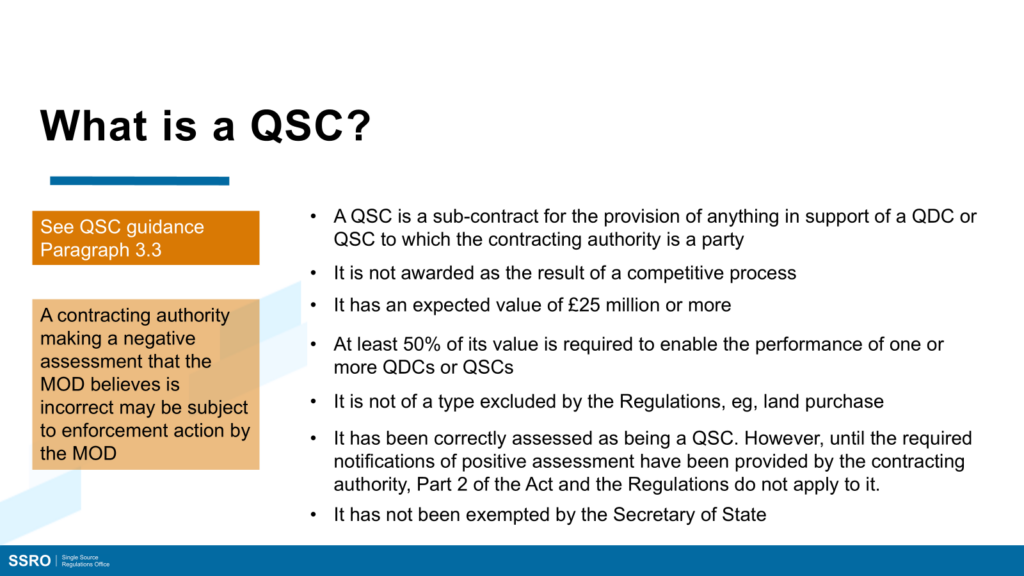
So what is a QSC?
Section 28 of the Defence Reform Act and regulation 58 set out the requirements that must be met for a contract to be a QSC to which the regulatory framework applies.
In summary a contract is a QSC if the following conditions are met.
- It is a contract between a contracting authority who is either a primary contractor under a QDC or a sub-contractor under a QSC and another person which involves the provision by the other person of anything for the purposes of a QDC or QSC to which the contracting authority is a party.
- The contract has not been awarded as the result of a competitive process.
- The contract has an expected value (as determined by the contracting authority under Regulation 5) which is £25 million or more.
- At least 50 per cent by value of the obligations under the contract is required to enable the performance of the QDC or QSC to which the contract is a sub-contract, or to enable the combined performance of the superior contract and any other QDCs or QSCs, or prospective QDCs or QSCs to which the contracting authority (or an associated person) is or might become a party. It’s not a contract which is of a type that is expressly excluded by the Regulations, for example:
- a contract within an international co-operative defence programme;
- a contract for the purchase or management of land; OR
- a contract related to the security services.
- The contracting authority has correctly assessed that the contract would be a QSC if entered into. However, until the necessary notifications of that assessment have been provided to the MOD and the prospective contractor, Part 2 of the Act and the Regulations do not apply to it. You can find out more about QSC notifications in an accompanying video in this series.
- AND FINALLY, the contract must not have been exempted from the regulatory framework by the Secretary of State.
If any of these conditions aren’t met the contract is not a QSC that is subject to the regulatory framework.
Please note also that if a contracting authority makes a negative assessment in respect of a proposed contract and the MOD believes that the assessment is incorrect the contracting authority may be subject to enforcement action by the MOD.
SLIDE 4
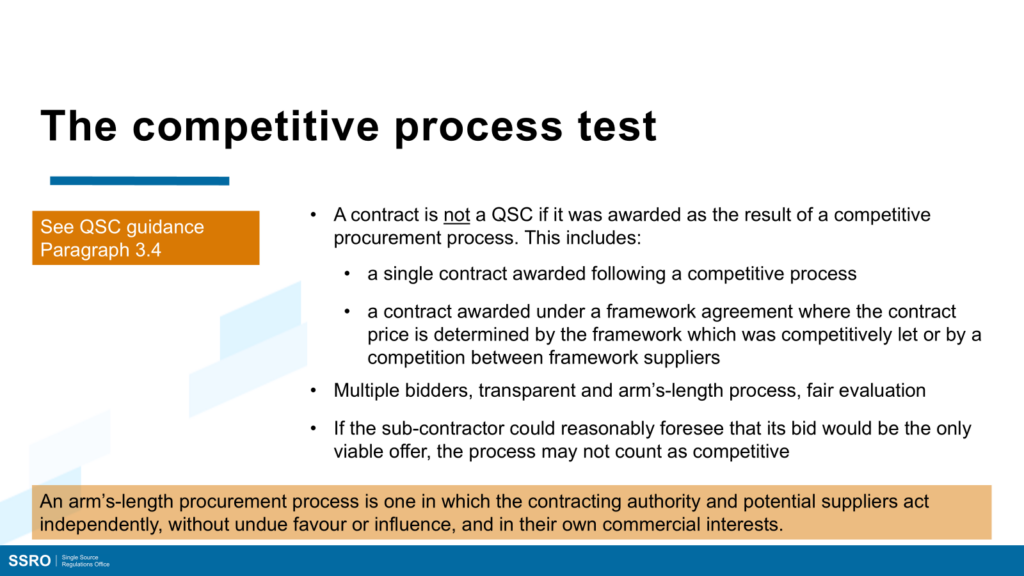
Only non-competitive sub-contracts can be QSCs. But what counts as a competitive process for the purposes of the QSC assessment?
Regulations 59 and 60 describe when the award of a contract is the result of a competitive process. This includes:
- a single contract awarded following a competitive process OR
- a contract awarded under a framework agreement where the contract price is determined either by the framework agreement which was entered into following a competitive process or by a competition between framework suppliers.
The process must have involved genuine competition in order to exclude the sub-contract from QSC status. That means including multiple bidders, a transparent and arm’s-length process, and fair evaluation.
If the sub-contractor could reasonably foresee that its bid would be the only viable offer, the process may not count as competitive.
Our QSC guidance gives further direction on what constitutes an arm’s length procurement process which is shown here. An arm’s-length process ensures that the procurement is conducted in the public interest and carried out in a manner that is fair, reflects market-based terms, supports effective competition, and guards against conflicts of interest or impropriety.
SLIDE 5
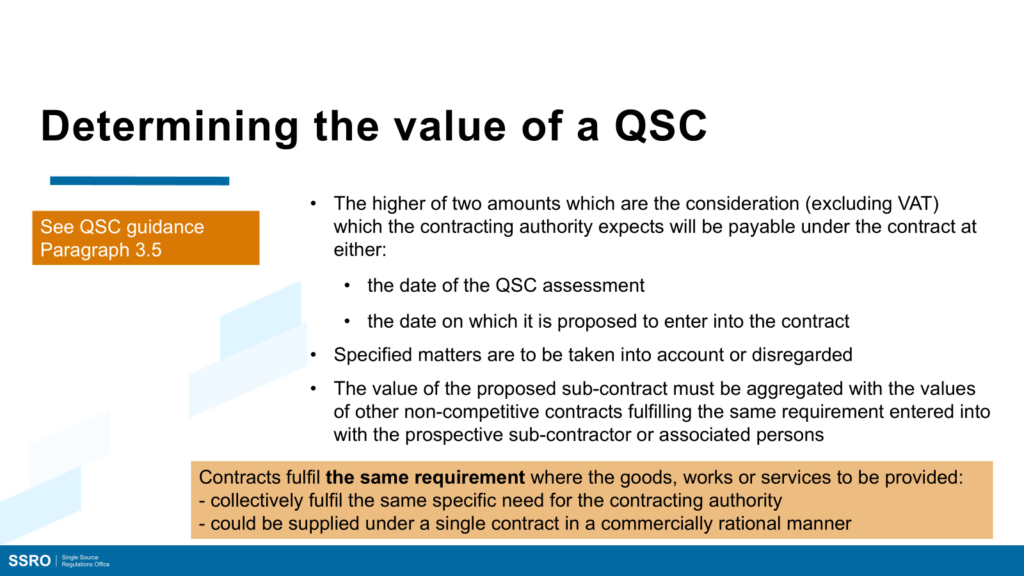
We noted earlier that for a contract to be a QSC it must have an assessed value of
£25 million and the value is to be determined by the contracting authority in accordance with regulation 5.
For QSC assessment purposes, contract value is calculated as the higher of the expected price (excluding VAT) at the date of the QSC assessment or at the date when it is proposed to enter into the contract.
Certain matters are to be included or disregarded in the value calculation. These are set out primarily in regulations 5(4) and 5(6).
Things to be taken into consideration include any options in the contract and the likely effect of inflation on any allowable costs under the contract.
Things which are to be excluded include the value of any resources, such as land or personnel, to be provided by the contracting authority.
Additionally, there is a requirement to aggregate the value of the proposed contract being assessed with the value of other related contracts when determining if the £25 million threshold is met. For this purpose, related contracts are other non-competitive contracts (or proposed contracts) that fulfil the same requirement for goods, works or services which the contracting authority has entered into (or proposes to enter into) with the prospective sub-contractor or associated persons… subject to certain exclusions related to the value of the other contracts. More on those in the next slide.
Whether or not sub-contracts entered into with the same person have the purpose of fulfilling the same requirementfor goods, works or services is a matter of judgement. Factors identified by our guidance as relevant to that assessment are shown here.
SLIDE 6
In this final slide, let’s look in a little more detail at aggregation for the purpose of determining the value of a proposed contract as part of a QSC assessment.
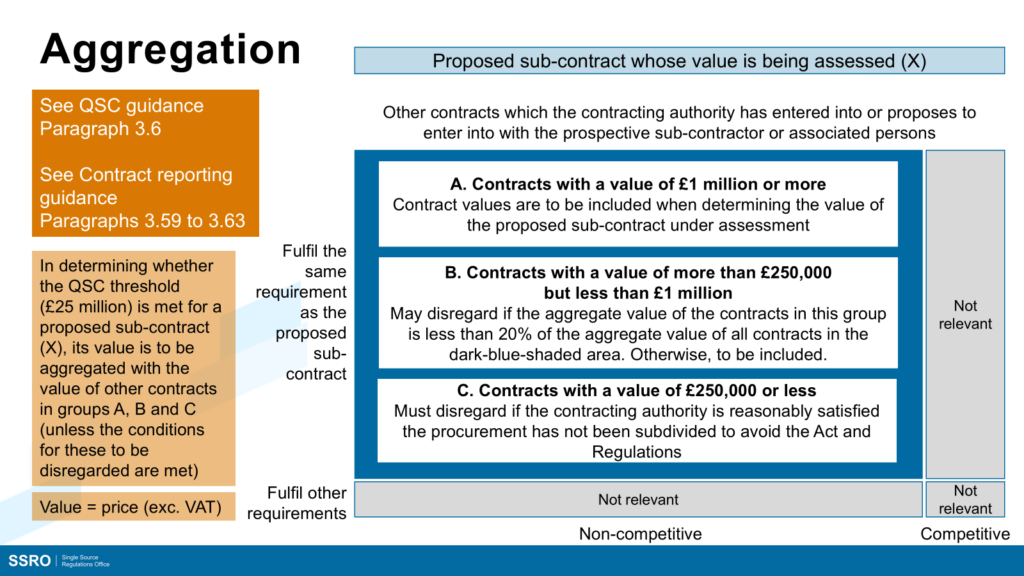
Each proposed sub-contract is to be assessed individually by the contracting authority. As we’ve just noted, there is a requirement to aggregate the value of the proposed contract being assessed with the value of other non-competitive contracts that fulfil the same requirementfor goods, works or services which the contracting authority has entered into (or proposes to enter into) with the prospective sub-contractor or associated persons… subject to certain exclusions related to the value of the other contracts.
So we show here, the proposed sub-contract being assessed and the population of other contracts which the contracting authority has entered into or proposes to enter into with the prospective sub-contractor or associated persons.
Among this population of contracts we are only interested in the ones which are not the result of a competitive process and which fulfil the same requirement for the contracting authority as the proposed sub-contract whose value is being assessed. So we can disregard any contracts which fall into the grey-shaded areas of the diagram.
Whether the contracting authority includes any contracts in the Groups A, B or C in its value assessment for the proposed sub-contract depends on the values (that is, prices excluding VAT) of those contracts.
Contracts with a value of £250,000 or less (Group C in the diagram) must be disregarded – provided that the contracting authority is reasonably satisfied that the procurement has not been subdivided in order to avoid the requirements of the Act and Regulations.
Contracts with a value of more than £250,000 but less than £1 million (Group B) may be disregarded if the aggregate value of the contracts in this group is less than 20% of the aggregate value of all the contracts in the dark-blue-shaded area. If the aggregate value of contracts in this group is 20% or more of the aggregate for all contracts in the dark-blue-shaded area they may notbe disregarded and will be included when determining the value of the proposed sub-contract for QSC assessment purposes.
Contracts in Group A, that is, with a value of £1 million or more may not be disregarded when determining the value of the proposed sub-contract for QSC assessment purposes.
Accordingly, the value of the proposed sub-contract for QSC assessment purposes is the sum of the expected price excluding VAT of that proposed contract and the prices (or expected prices) excluding VAT of the contracts in Groups A, B and C unless the conditions for these to be disregarded are met.
If this equals £25 million or more, the proposed contract meets the value threshold to be a QSC. However, you should also note that a proposed sub-contract whose value prior to aggregation with other contracts is £1 million or less will not be treated as a QSC unless the contracting authority is reasonably satisfied that the procurement has been subdivided to avoid the requirements of the Act and Regulations.

Thank you for your interest in this video. Should you have any queries regarding the content covered, or require further assistance on applying the regulatory framework for single source defence contracts, you can contact the SSRO’s Helpdesk using the details shown here.