
This video examines how the price of a qualifying sub-contract is to be agreed. Chapter 5 of the SSRO’s guidance on qualifying sub-contracts includes guidance on agreeing the price of a QSC.
TRANSCRIPT AND SLIDES AS USED IN THE VIDEO:
SLIDE 1
This video examines how the price of a qualifying sub-contract is to be agreed.
SLIDE 2
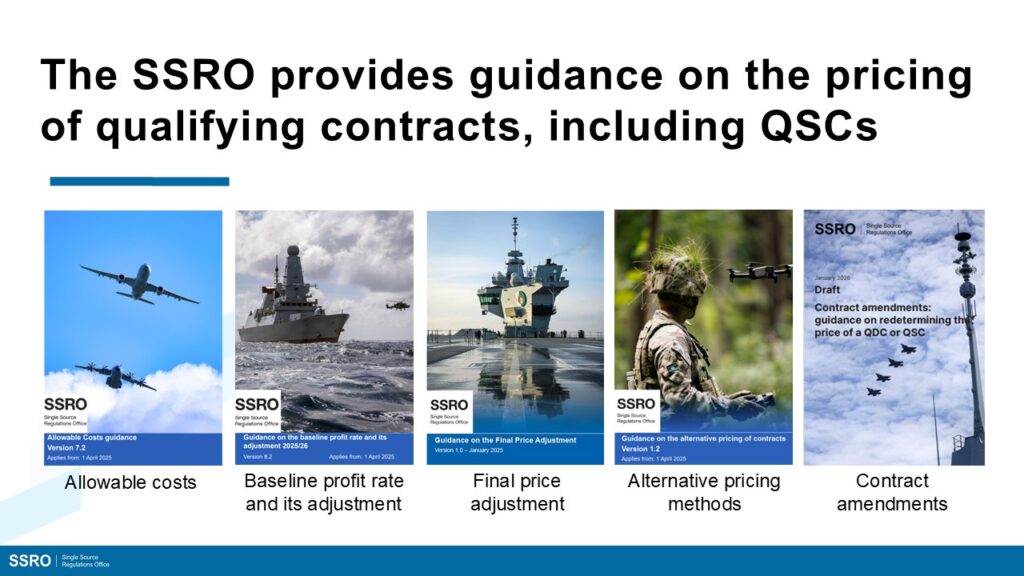
The Defence Reform Act 2014 and the Single Source Contract Regulations 2014 specify how qualifying contracts must be priced. These requirements apply to QSCs (and to sub-contractors) as they apply to qualifying defence contracts (QDCs) (and to primary contractors), subject to certain modifications set out in regulations 64 and 65.
The SSRO provides a range of guidance on the pricing of qualifying contracts under the regulatory framework.
All are available on our website.
The guidance covers:
- The determination of allowable costs.
- The steps to be applied to calculate the contract profit rate.
- Application of the final price adjustment.
- Alternative pricing methods.
- Guidance on how the price of a contract which is subject to a pricing amendment should be re-determined.
The remainder of this video highlights the ways in which the contract-pricing requirements are modified for application to a QSC.
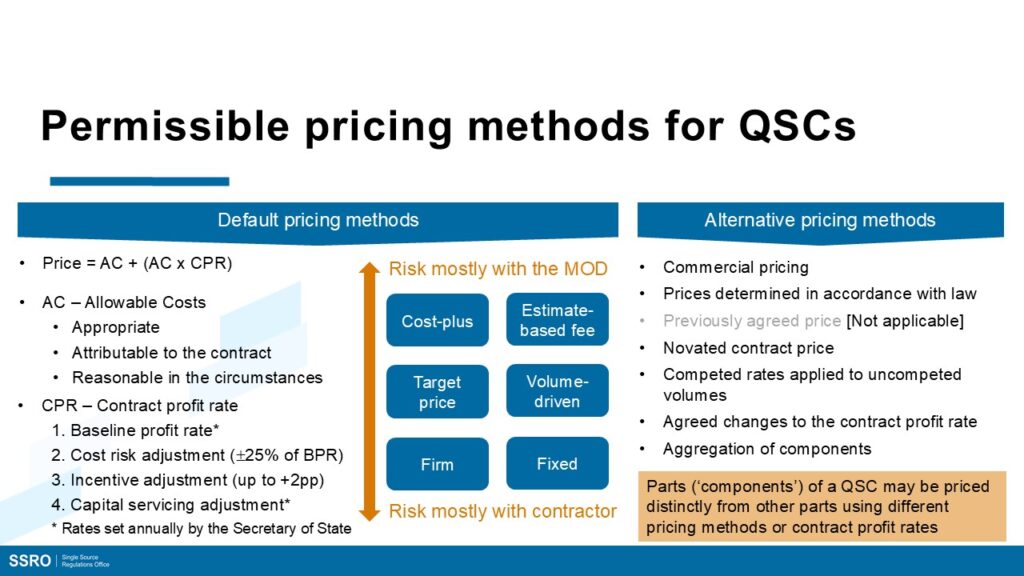
The regulatory framework sets the methods by which the price of a qualifying contract may be determined.
There are six default pricing methods under which the price payable under a QSC is determined by a price formula which applies a profit mark-up to allowable costs.
The Allowable Costs must meet the requirements of being appropriate, attributable to the contract, and reasonable in the circumstances (or AAR). The different default pricing methods determine whether the allowable costs are estimates of the costs the contractor expects to incur as determined at the time of agreement (in some cases adjusted by indexation) or the actual allowable costs incurred by a contractor. This determines whether cost risk is mostly being transferred to the contractor or retained by the MOD.
The contract profit rate under the default pricing methods is determined using a 4-step process set out in the Regulations. Step 1, the baseline profit rate is determined annually by the Secretary of State informed by an SSRO recommendation.
The adjustments to the baseline profit rate allow the contracting parties to tailor the profit element of the price to reflect (at step 2) the financial risk to the contractor of entering into the contract, (at step 3) the need for a financial incentive to achieve performance targets under the contract, and (at step 4) the capital intensity of the activities being performed.
Since 1 April 2024, the Regulations have also provided for a number of alternative pricing methods. These may only be used in specified circumstances. Typically, this means they may be used where applying the pricing formula may not be possible or where a fair price can be established by other means, for example, through reference to a market price for the goods or services being contracted for.
Six of the seven alternative pricing methods are available for use under QSCs. The Previously agreed price pricing method is not applicable to a QSC because it is not possible for a contract which was not originally assessed as being a QSC to become a QSC at a later date.
The parties to a QSC may agree that a part of that contract is to be priced distinctly from other parts of that contract. This might be through using either a different pricing method or agreeing different contract profit rates for different parts. These distinctly priced parts of a contract are referred to as components under the regulatory framework. Where a contract is comprised of components there will be additional reporting requirements for contractors. For this reason, and to avoid unnecessary complexity in contract pricing, some care is needed when deciding how the price of a QSC is to be structured.
SLIDE 4
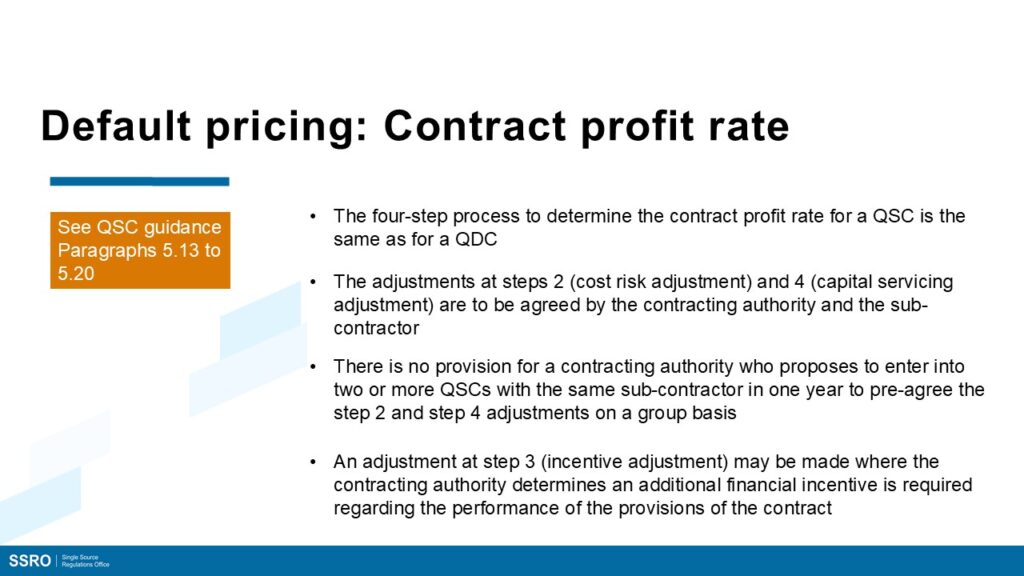
The provisions of the Act and Regulations which are relevant to the determination of the contract profit rate are modified for a QSC or a component of such a contract (when compared to the approach taken for QDCs). The main changes are that:
- The adjustments at steps 2 (cost risk adjustment) and 4 (capital servicing adjustment) are to be agreed by the contracting authority (rather than the MOD) and the sub-contractor. The basis on which the adjustments are to be agreed is the same as it is for QDCs.
- There is no provision for a contracting authority who proposes to enter into two or more QSCs with the same sub-contractor within the period of one year to agree these adjustments on a group basis (as may be agreed between the MOD and a primary contractor). The adjustments must be agreed on a contract-by-contract basis.
- An adjustment at step 3 (incentive adjustment) may be made at the discretion of the contracting authority where the contracting authority (rather than the MOD) determines an additional financial incentive is required regarding the performance of the provisions of the contract.
SLIDE 5
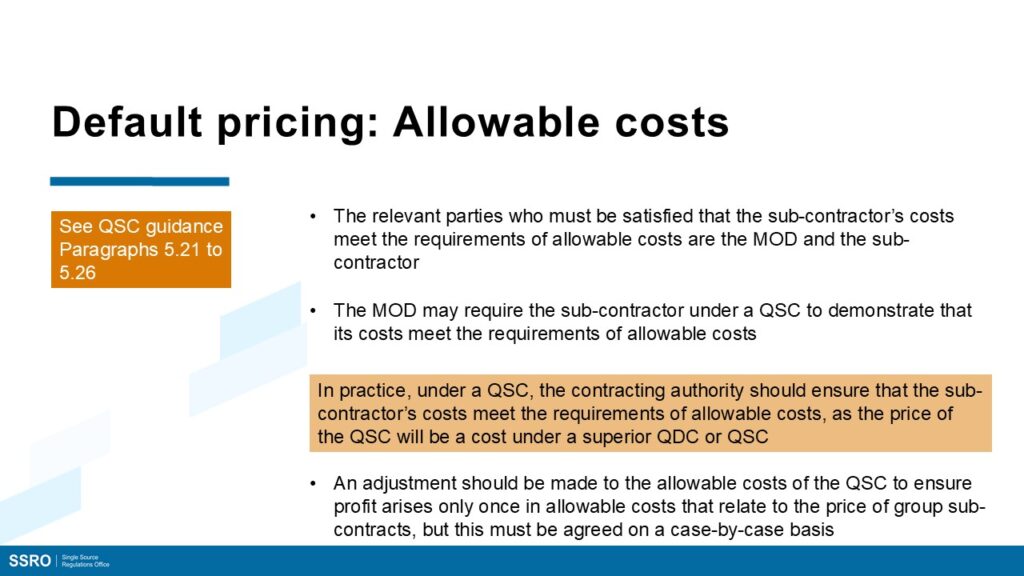
The provisions of the Act and Regulations which are relevant to the determination of allowable costs are also modified for a QSC or a component of such a contract (when compared to the approach taken for QDCs). The main changes are that:
- It is the MOD and sub-contractorwho must be satisfied that the sub-contractor’s claimed costs under the QSC meet the requirements of allowable costs
- And it is the MOD (not the contracting authority) who may require the sub-contractor to demonstrate that its claimed costs meet the requirements of allowable costs.
In practice, as the price of a QSC will be a cost to the contracting authority which will inform the price of a superior QDC or QSC, the contracting authority should ensure that the sub-contractor’s costs meet the requirements of allowable costs. The contracting authority will either receive assurance on this from the MOD or will obtain its own assurance if the MOD has authorised it to agree the allowable costs under the QSC on the Secretary of State’s behalf.
As with a QDC, an adjustment should be made to the allowable costs under a QSC, to prevent profit being counted twice on work sub-contracted on a non-competitive basis with connected persons. Our guidance refers to this as a POCO (Profit on costs once) adjustment. However, while the Regulations allow for POCO adjustments to be agreed on a group basis for multiple QDCs, there is no equivalent provision to agree a group POCO in advance for multiple QSCs entered into in a given year.
SLIDE 6
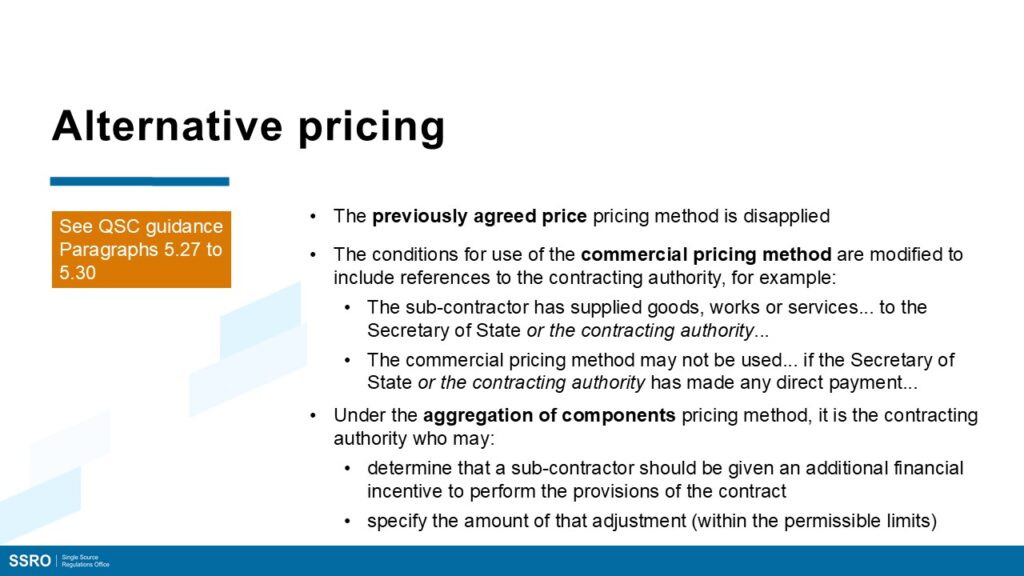
We have already noted that the previously agreed pricealternative pricing method is not applicable to a QSC because it is not possible for an existing contract to become a QSC by way of a contract amendment.
There are also some other modifications to the regulatory provisions that relate to alternative pricing when applied to a QSC.
In relation to the commercial pricing method, while it remains the case that the MOD must be satisfied that the circumstances for use of the methodexist, the circumstances themselves are modified to include references to the contracting authority: For example:
- The sub-contractor has supplied goods, works or services under a contract to the same or substantially the same specifications… to the Secretary of State or the contracting authority… AND
- The commercial pricing method may not be used… if the Secretary of State or the contracting authority has made any direct payment… for the development of those goods, works or services.
Also, under the Aggregation of components pricing method, it is the contracting authority rather than the MOD who may determine that a sub-contractor should be given an additional financial incentive (the total incentive adjustment) to perform the provisions of the contract and it is the contracting authority who may specify the amount of that adjustment (within the permissible limits).
SLIDE 7
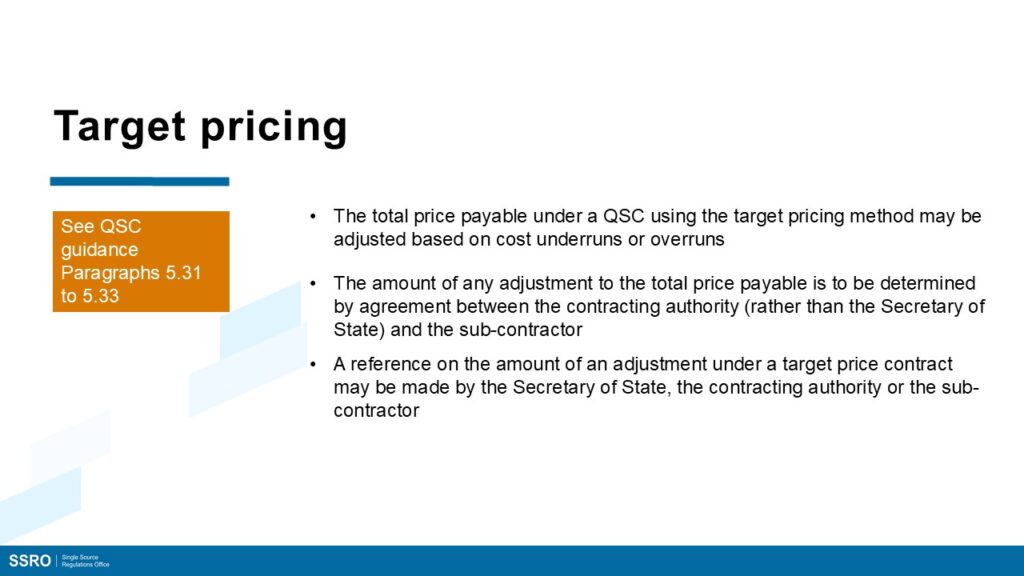
Under the target pricing method, one of the default pricing methods highlighted earlier, the total price payable under a qualifying contract (or a component of that contract) may be adjusted where there is a difference between the contractor’s actual allowable costs under the contract (or component) and the estimated allowable costs used to determine the target price.
The legislative provisions related to target pricing are modified for application to QSCs so that the amount of any adjustment is to be determined by agreement between the contracting authority (rather than the Secretary of State) and the sub-contractor (or by the SSRO if the matter is referred to us).
A reference on the amount of an adjustment under a target price contract may be made by the Secretary of State, the contracting authority or the sub-contractor.
SLIDE 8
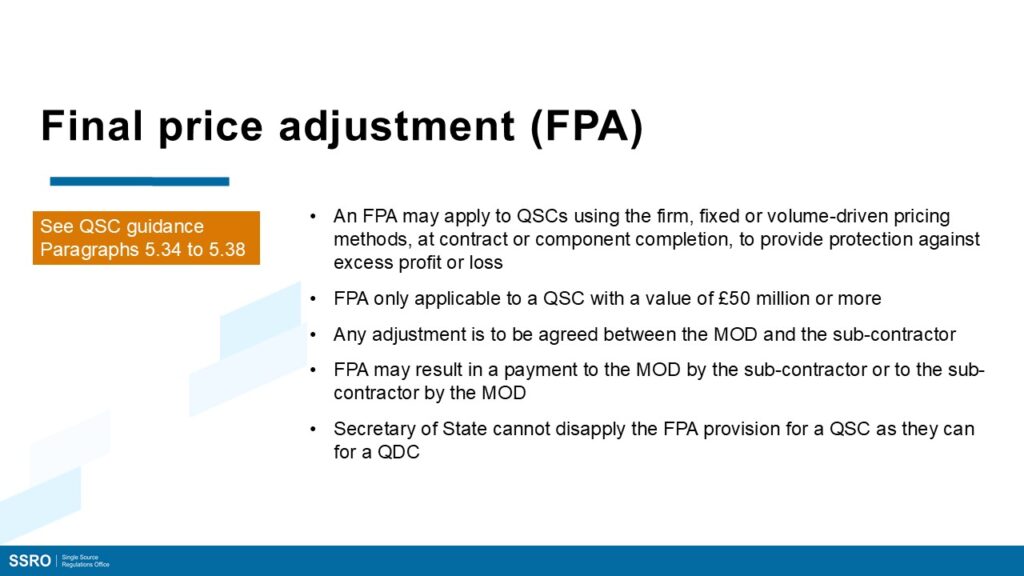
The Act and Regulations provides a mechanism (the Final Price Adjustment or FPA) by which the price payable under a QSC or a component of such a contract that is priced using the firm, fixed, or volume-driven pricing methods may be adjusted at contract or component completion if the sub-contractor’s profit is above or below defined thresholds.
Unlike for QDCs, for QSCs, the FPA provision only applies if the contract value is £50 million or more.
Where a FPA does apply to a QSC, the adjustment (refund of excess profit or payment for loss) is to be agreed between the MOD and the sub-contractor and will result in a payment between those parties.
Unlike for a QDC, the Secretary of State cannot disapply the provision for a final price adjustment in the case of a QSC.
SLIDE 9
Thank you for your interest in this video. Should you have any queries regarding the content covered, or require further assistance on applying the regulatory framework for single source defence contracts, you can contact the SSRO’s Helpdesk.